Showing posts with label innovation. Show all posts

Wednesday, August 31, 2011

Mercedes-Benz innovation: NANOSLIDE technology for lower consumption and minimised friction losses


After five years and use exclusively in AMG engines, twin‑wire arc spraying technology will now also be used in the series production of Mercedes-Benz diesel engines. Mercedes-Benz was the developer of what is now known as NANOSLIDE technology, in which twin-wire arc spraying is used to melt iron/carbon wires and spray them onto the cylinder surfaces of the lightweight aluminium crankcase with the help of a gasflow. Very fine finishing of the resulting nano-crystalline iron coating creates an almost mirror-like, smooth surface with fine pores, which reduces friction and wear between the piston assembly and the cylinder wall. Other advantages include lower engine weight, less fuel consumption and lower emissions. This innovation from Mercedes-Benz has been successfully used in the 6.3-litre AMG engines since 2006.


Mercedes-Benz uses the collective term BlueEFFICIENCY to describe a whole range of different measures designed to reduce fuel consumption and emissions: sophisticated aerodynamics, weight-saving measures and intelligent control of ancillary units are a few examples. With NANOSLIDE technology, the world's oldest automobile manufacturer is adding another innovation to this technology package. It sets new standards in the production of cylinder linings. These help to ensure that the piston moves up and down within the cylinder with the least possible friction losses. Comparatively heavy grey cast-iron liners with a thickness of up to five millimetres are the current state of the art.


The NANOSLIDE procedure takes a new approach. Wires of iron/carbon alloy are melted in an electric arc, and the melted material is "sprayed" onto the cylinder wall by a gasflow, where it is deposited as a layered, ultra-fine to nano-crystalline coating. The NANOSLIDE coating is then given an extremely smooth finish by a special honing process, after which it has a thickness of only 0.1 to 0.15 millimetres and has a mirror-like surface. The honing process also exposes pores in the material which are able to retain oil and thereby ensure optimal lubrication of the piston assembly. The result is not only low friction, and therefore greatly reduced mechanical friction losses compared to grey cast-iron cylinder liners (up to 50 percent), but also extremely high wear resistance.


Mercedes-Benz has plenty of experience with its in-house development of NANOSLIDE technology. In July 2005 Mercedes-AMG GmbH presented a 6.3‑litre V8 which not only delivered outstanding performance figures, but was also the world's first series production engine to feature cylinder walls with a twin-wire arc sprayed coating. Since 2006 this cutting-edge cylinder coating technology has been a key component of all 6.3-litre AMG engines. The procedure has proved highly successful in more than 75,000 high-performance AMG engines to date, and meets all expectations. The specialist term "NANOSLIDE" has meanwhile become an accolade. The process involves numerous new inventions and ideas, and is protected by more than 90 patent families and over 40 patents.


In view of this positive experience, Mercedes-Benz is the world's first manufacturer to have developed this technology further for use in a V6 diesel engine.

NANOSLIDE reduces the engine weight by 4.3 kilograms compared to the preceding engine, and brings an additional fuel saving of 3 percent. The V6 diesel engine in the ML 350 BlueTEC, for example, develops an output of 190 kW (258 hp) from a displacement of 2987 cc, and generates 620 Nm of torque. Thanks to BlueTEC with AdBlue® exhaust treatment, this M-Class model already meets the emission values planned for 2014 in accordance with the Euro-6 standard, and as such is one of the world's cleanest diesel vehicles. With a combined consumption of 6.8 litres of diesel per 100 kilometres, the ML 350 BlueTEC improves on the figures of its predecessor by 2.1 litres, or 24 percent. CO2 emissions have dropped from 235 to 179 grams per kilometre, not least thanks to the new NANOSLIDE technology.


Source: Daimler AG


Copyright © 2011, Mercedes-Benz-Blog. All rights reserved.

Tuesday, December 4, 2007

Saturday, April 14, 2007

What hot rodders do when they want to build a model car?


The St. Joe Valley Street Rod Club, with members located in the South Bend, Indiana... created a display, including the box, that replicates an early 1960's AMT plastic 3-in-1 model kit of a 1940 Ford coupe, using an actual '40 Ford and associated car parts and kit building items (paint bottles, glue tube, etc.).

A "tree", one of two, was created to hold actual flathead engine parts, including a block and heads. The second tree replicates one that held chrome parts such as nerf bars, bumpers and wheel covers.

Saturday, March 17, 2007

Tuesday, December 19, 2006

Smokey's Chevelle

The quintessential Yunick story has been retold so many times, and exaggerated so much in the telling, that today it’s almost unbelievable. The facts, if they can still be determined, are that Yunick showed up with a Chevelle at Daytona in 1967 for Curtis Turner to drive.

Turner won the pole, and the big manufacturers blew a gasket–a lone privateer wasn’t supposed to show up the factory teams like that.

The car blew up on the second lap of the race, avoiding further controversy, but when Yunick brought the car to the summer Daytona race, NASCAR inspectors, determined not to let their primary manufacturers be embarrassed again, gave Yunick a list of eleven mechanical items that had to be fixed before qualifying–which started in ninety minutes.

(Item #1, reportedly, was “Replace homemade frame with stock frame.”)

They removed the gas tank from the car, claiming that its non-exploding design was non-conforming. Yunick in exasperation told them, “Make that twelve items,” hopped into his tankless Chevy, and drove it back to its garage stall as the red-faced inspectors gaped.

The rulebook didn’t specify what kind of fuel lines the car could run, so Yunick had threaded eleven feet of 2" tubing through the frame, allowing it to hold almost a gallon of additional gas.

Within a week, the rulebook had been changed to allow only 5/8" tubing of a short length.

From http://www.gordonline.com/commish/020105.html and probably a dozen other sources.

From http://www.smokeyyunick.com/PressReleases/Reviews.pdf is a bit Smokey said after Earnhardt's death:
Yunick writes: “Moveable walls, concrete tracks, fueling by computer, air jacks ’stead of the 30 pound flying sledge hammers they use, mandatory retirement age, etc. When the hell they gonna get to doing something? Maybe after next ace gets killed? When they gonna get rid of the [deleted] restrictor plates and go to smaller engines? Don’t give me the [deleted] answer you can get killed in bathtub. It’s this simple: whoever’s running NASCAR has got his head up his [deleted].”

http://grantwcooper.com/smokey.html has a terrific tribute website, and so is http://www.legendsofnascar.com/smokey.htm

For more about Smokey: http://justacarguy.blogspot.com/2008/11/great-racing-photos-and-warbirds-and.html

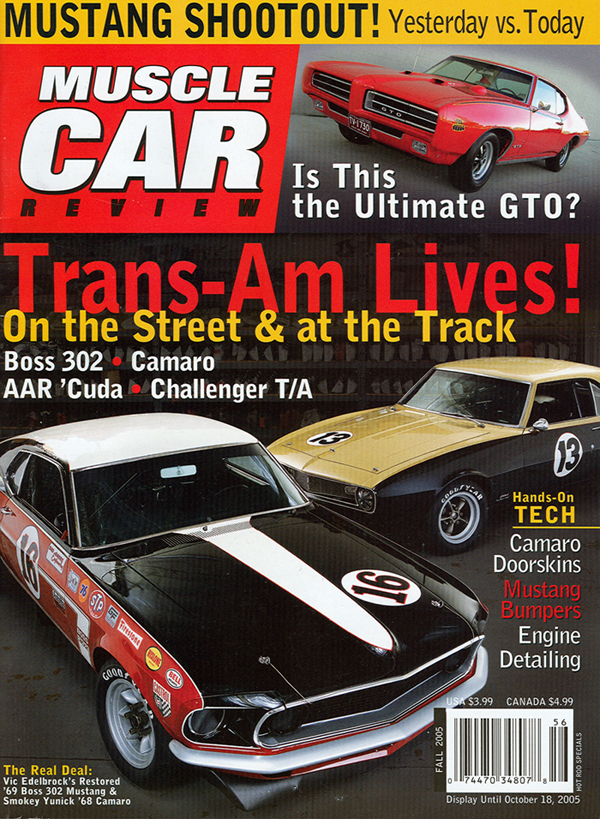
Smokey Yunick's Boss 302


Some of the fine artwork that Smokey performed on this 180 mph beast...

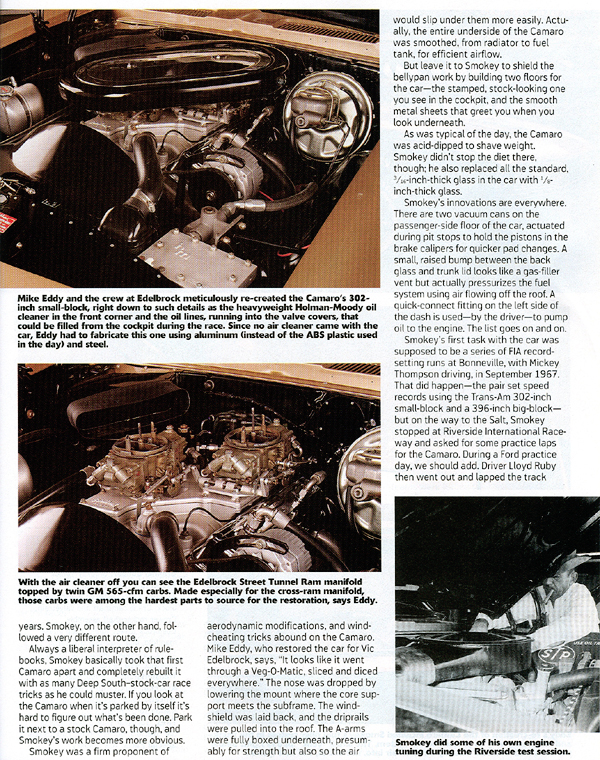
He took the starter, reversed the direction it pointed, reversed it's spinning direction, and mounted it next to the oil pan.... just to make room for the exhaust 4 into 2 into 1 hand welded collectors.

He took a wrong side / passenger side Australian steering box, and installed it in order to make room for exhaust on the opposite side from the starter mod I just mentioned.

For a better description of the tricks I just mentioned
http://www.trans-amseries.com/Drivers/RossMyers69Mustang.htm

http://www.ponysite.de/smokey.htm for more pictures

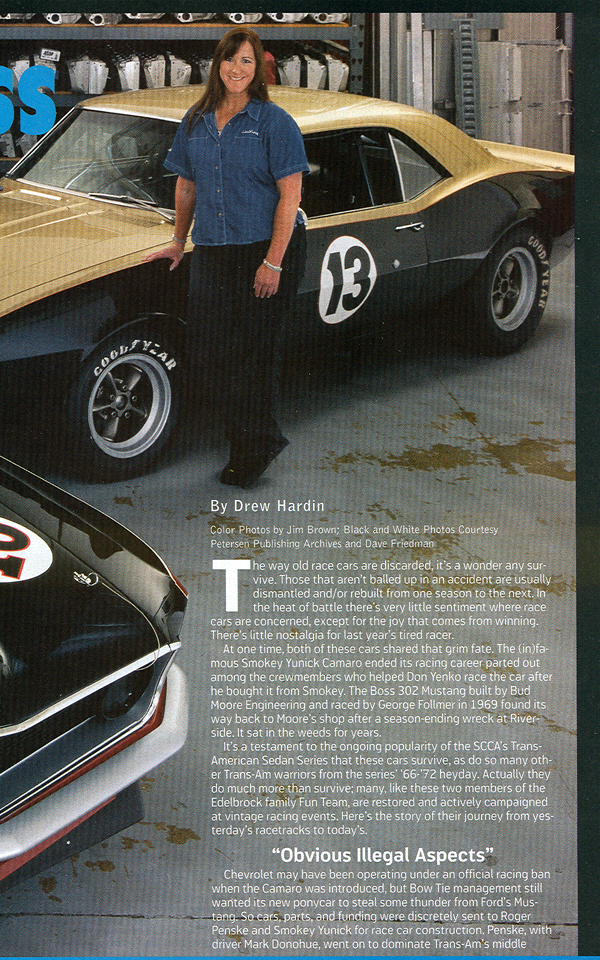
Now the conflicting info about this car is that one website says Vic Edelbrock owns and races it. Pictured here: http://www.trans-amseries.com/Drivers/VicEdelbrockMustang.htm is the formerly Follmer Boss 302. So, what's that about?

This website http://www.gordonline.com/commish/020105.html says Edelbrock owns the Smokey 302.... wonder why?